
Open source · MIT licensed
An AI Research IDE Powered by Agents
Work with AI agents to propose, build, test, and refine models for supervised scientific machine learning.
You work through a coding agent such as Claude Code or Codex: describe your data and goal, and it writes your task and experiment as files you review.


See SIDERIUS in under three minutes
A 2:35 introduction, with captions.
Define it.
Turn your dataset and research question into a verifiable task package: data, objective, metrics and validity checks in one place.
Solve it.
Let agents propose, build and test models, iteration after iteration, inside the rules you set.
From the paper
Exploration and LLM cost on TIDMAD
Six runs on one task, on the same log-scale cost axis.
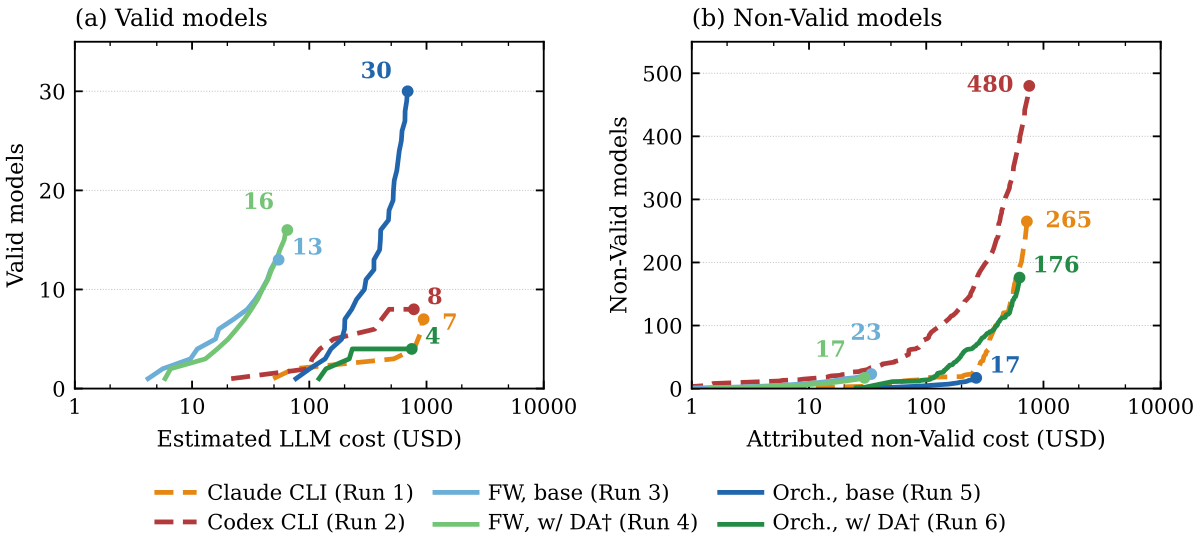
- SIDERIUS orchestration, base: 30 valid
- SIDERIUS fixed workflow, with data analysis: 16 valid
- SIDERIUS fixed workflow, base: 13 valid
- Codex CLI: 8 valid
- Claude Code CLI: 7 valid
- SIDERIUS orchestration, with data analysis: 4 valid
- Codex CLI: 480 non-valid
- Claude Code CLI: 265 non-valid
- SIDERIUS orchestration, with data analysis: 176 non-valid
- SIDERIUS fixed workflow, base: 23 non-valid
- SIDERIUS fixed workflow, with data analysis: 17 non-valid
- SIDERIUS orchestration, base: 17 non-valid
General coding agents
- Claude CLI (Run 1)valid models 7, non-valid models 265
- Codex CLI (Run 2)valid models 8, non-valid models 480
SIDERIUS fixed workflow
- Fixed workflow (Run 3)valid models 13, non-valid models 23
- Fixed workflow with data analysis (Run 4)valid models 16, non-valid models 17
SIDERIUS orchestration
- Orchestration (Run 5)valid models 30, non-valid models 17
- Orchestration with data analysis (Run 6)valid models 4, non-valid models 176
- Most valid models30SIDERIUS orchestration
- Lowest LLM cost< $100SIDERIUS fixed workflow
- Fewest non-valid models17SIDERIUS, vs 265 and 480 for coding agents
What makes it different
A research loop
Each iteration writes new model code and learns from the last.
Validity, not just score
Task-declared Health checks sit next to your metric.
Fixed workflow or orchestration
Run capabilities in a fixed order, or let a language model choose which to call next.
You stay in charge
Your coding agent asks before scientific choices and paid runs, and a loop can pause to ask for your advice.
Works with the models you already use
Choose a model for each capability from six providers. Each capability can use a different one.
- OpenAIOpenAI
openai - GeminiGoogle
gemini - DeepSeekDeepSeek
deepseek - ClaudeAnthropic
anthropic - KimiMoonshot AI
moonshot - GLMZ.AI
zai
How it works
One lap is one research iteration
Agents reason. Deterministic code selects data, trains, scores and checks validity.
You bring the science. SIDERIUS runs the rest.
1 · You decide
- Data & model inputs/outputs“My MNIST images and labels are in /data/mnist”
- Goal & metric“optimize validation accuracy”
- What counts as valid“Keep the test split out of search feedback”
2 · Task package
- Data & model I/O
- Goal & metric
- Validity checks
Declared once, reused by every run.
3 · SIDERIUS does
Propose, build and test models
- Propose
- Implement
- Validate
- Train & tune
- Interpret
- Train, score and check validitydeterministic training, inference and scoring
- Record everything, resume safelyprovenance, reproducibility and resume
You keep the scientific choices; SIDERIUS does the repetitive, auditable work.
Source: SIDERIUS docs (opens in a new tab) · What a task package declares (opens in a new tab)
Reported results
Results against published reference models
Physics time series
Validation R²
| Task | SIDERIUS | S4D |
|---|---|---|
| TESS | SIDERIUS 0.848 S4D 0.665 | |
| LIGO | SIDERIUS 0.760 S4D 0.125 | |
| Project 8 | SIDERIUS 0.857 S4D 0.704 | |
Cancer gene identification
Best Formal test AUPRC
| Task | SIDERIUS | TREE |
|---|---|---|
| MTG | SIDERIUS 0.822 TREE 0.540 | |
| LTG | SIDERIUS 0.859 TREE 0.731 | |
| PCNet | SIDERIUS 0.823 TREE 0.672 | |
| Multinet | SIDERIUS 0.809 TREE 0.686 | |
| STRINGdb | SIDERIUS 0.815 TREE 0.765 | |
| IRefIndex v9 | SIDERIUS 0.737 TREE 0.681 | |
| CPDB | SIDERIUS 0.785 TREE 0.791 | |
| IRefIndex v15 | SIDERIUS 0.801 TREE 0.815 | |
Source: SIDERIUS paper (opens in a new tab) and README (opens in a new tab)